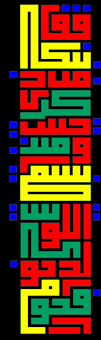
Abdallah AKAR - CALLIGRAPHY LESSON
When penetrating into A. AKAR's workshop, one is struck by
the profusion of papers and colours. This place seems related
sometimes to the chemist's laboratory and sometimes to the printing
house.
Perhaps one should see there the expression of his research:
medium and colour ?
Facing A. AKAR's work, one cannot confine calligraphy to the
art of "beautiful writing".
He nevertheless claims his faithfulness to tradition and is tirelessly searching for perfection of the stroke, exactitude in the gesture. Every day he draws hundreds of signs and words on the sheet of paper. He knows that he'll never know, that he still has to learn: to try, to do it again.
He remains a humble disciple of his Master Ghani ALANI. Maybe does he thus insure his attachment to "the spirit of the Letter", to tradition?
And if he escapes, it is by conceiving a new space, changing the receptacle for the line: mere wrapping paper or tanned leather; no hierarchy,-only the dressing matters.
To receive the noble writing, no need for luxury (gold will come later to finish off the work): strange alchemy leading from the egg and glue spread out, to a smooth, silky surface on which the hand, guiding the calame Iike a choreographer, is going to create movements in an almost immutable harmony.
This is the time for ultimate concentration.
Then tension eases down and A. AKAR recovers his artist's freedom,
his lightness - but not carelessness-, fantasy - but always rigor-.
He allows colour to penetrate, suggests motives, illuminates
and gilds.
A. AKAR's work proves to us that calligraphy is not a fossilized craft; he leads us from the old to the new, from the distant to the close. His look doesn't stop at the narrowness of words' meaning: text is but the redundancy of gesture. The line is a guide.
A. AKAR delivers an unambiguous work to us, with many possible readings, and where the eye is never lost.
A long apprenticeship
When approaching fine arts and calligraphy, it is well-advisable to start by copying the great masters, so as to refine one's aesthetic vision. But patience is not sufficient. One has to acquire good breath control. Before calligraphying a letter or a word, one has to foresee the places where it will be possible to take one's breath back, and at the same time, to take some more ink. Calligraphers who are perpetuating traditional methods do not like to use fountain pens because they generate an uninterrupted flow of ink. As a result, breath control is no longer necessary and the calligrapher loses the pleasure of "feeling the weight of time". Along with patience and breath control there is a third rule thrusting itself upon the calligrapher: concentration. It excludes any external concern and constraint. Only then can the calligrapher infringe these rules and compose with his own sensibility.
(From "La calligraphie au Château", Osny)
Sheep's vool
"When you're a child, at the Koranic school, the teacher alvays asks you to dip the quill, in this case the, a piece of reed, in the ink and to taste the ink. This creates a carnal bond with the written matter and at the same time, you symbolicaIly "taste knowledge". Then, Abdallah Akar explains how this ink is made up: With wool from the sheep's belly, mixed up with gum and saffron in order to obtain a golden colour. In the Muslim culture, calligraphy was the art of Sacred Writings retranscription, just like in our western society, monks would retranscribe precious writings.
But Abdallah Akar explains that with the opening of the Muslim world to western art, sources of inspiration for calligraphy have diversified. For instance, he has transcribed "Paroles" by Prévert or poems by Aragon. But always taking care of using the letter as raw material, and setting it like music on a white page.
(From "les calligraphies d'Abdallah Akar. The taste of ink", Courrier de l'Ouest, Angers, March 5th, 1992).
Calligraphy demands patience, concentration and breath control.
Calligraphying; is a ceremonial. Time and space have to be totally
rethought. Paper and inks have to be carefully prepared. Each
calligrapher has his own recipes, his own secrets, never unveiled.
Long before the Muslim era, Arabian writing, like Hebrew, comes
from the Phoenician alphabet. Like Hebrew, Arabian writing is
written and read from right to left. It comprises eighteen letters
which, combined with dots, make up to twenty-nine characters.
The original feature of this script is its ability to lend itself
to prodigious metamorphosis. That's how it became one of the
essential decorative elements of mosques and other monuments.
Taghor, the Indian poet, used to write: "If my own life is but an exact copy of my father's, why, then, did he disappear, and why was I born?" Can one speak of evolution or change in the world of Arabian calligraphy ? The question remains permanently asked to all those interested in this craft.
Arabian and Iranian calligraphers are confronted to Western art and a number of them complete their training by going to a fine-arts school in the West or in their own country. The calligrapher is no longer isolated. His pictures are shown next to any painter's. Some have taken the plunge and do not use the calamus to draw the calligraphic line any more. Must the use of the letter be forbidden to them, and are they usurping the title of calligrapher ? The quarrel and the struggle between those for whom the letter drawing must remain pure and those asserting that the letter is a plastic element which every artist may use as he pleases are more present each day.
One probably could analyze this evolution and, at the reading of most recent creations, redefine what calligraphy really is at the dawn of the XXIst century. That's what Charbel Dager tried to do in his recentIy published book (Al-houroufia al-'arabia, Beyrouth). If calligraphy has travelled and found new inspiration sources (out of the Sacred Book) or new plastic expressions, it did inspire Western artists as well: Paul Klee, by introducing the Arabian letter in his work, has opened a field of inspiratien expanding wildly today. And numerous sculptors, architects and artists, after Klee, have worked with and around the letter in a manner that differs from classical composition.
No doubt it's time to accept all the tendancies for they can only enrich this major artform. Calligraphy is not an art from the past, it is a living art.
Abdallah Akar
(Revue Culturelle en franocais et en arabe, Decembre 1991)